

Inevitably in life, we encounter threats to our well-being, and indeed some threats may challenge our very survival. In order to survive, we must be prepared to cope with such threats and adversities. Fortunately, the brain can help us by mobilizing protective programs that recruit the help of both our bodies and our minds. Unfortunately, these programs may also malfunction and cause disruption of our lives.
When a threat menaces us, the brain quickly turns on body programs that help to meet the challenge. They increase blood flow to heart, brain and muscle and they increase the supply of energy. As time passes, these programs also regulate genes that control basic survival functions. By turning on these programs, the brain prepares us to beat back attackers, or if it seems the better choice, to flee from them and escape.

The brain does not just activate body-state programs, the brain also alerts the mind to impending danger. When we are subjected to imminent danger or emotional harm, we experience fear, an unpleasant mind state that couples heightened awareness to a sense of unease and an apprehension that something bad is about to happen. We may also experience anxiety, which is a sense of unease that differs from fear in that it may be induced by a danger that is imagined and not actually imminent. Anxiety may be especially strong if the imagined danger is thought to be unavoidable or out of our control. Continued fear and anxiety cause stress, which is the effect on our bodily processes of these negative brain states.
Our brains create fear and anxiety to protect us. Fear changes our behavior when danger is on the horizon. We become alert and focus on how to protect ourselves. These reactions to real or perceived danger are profound and span the mental, the physiological and the behavioral states of body and mind.
Fear and stress reorganize our body processes to meet perceived or imagined challenges.

The brain prepares the body for threat by activating two body systems, the sympatho adreno medullary (SAM) system and the Hypothalamic-Pituitary-Adrenal (HPA) axis. The SAM system activates the sympathetic component of the autonomic nervous system, the part of the nervous system that prepares the body for “fight or flight”. The SAM system triggers the release of the neurotransmitters, epinephrine and norepinephrine from the adrenal medulla. These increase heart rate and the flow of blood to the brain and muscles. They stimulate breathing and the breakdown of glucose from glycogen in the liver, increasing the body’s supply of energy. These increases in blood pressure, respiration and energy prime us for fighting, or in case it appears we will be overwhelmed by the threat, for fleeing.
The HPA pathway acts more slowly and is activated by stress. Stress stimulates hypothalamic CRH and AVP, which act on the anterior pituitary to release ACTH; ACTH then stimulates the adrenal cortex to release glucocorticoids. Glucocorticoids are steroid hormones that can pass through cellular membranes and bind to receptors that enter the nucleus to regulate gene activity. One action of glucocorticoids is to repress the immune system by down-regulating genes for signaling molecules called inflammatory cytokines. Glucocorticoids down-regulate these genes by inhibiting a transcription factor called NFkB, whose activity enhances cytokine expression. To inhibit NFkB, glucocorticoids must bind to glucocorticoid receptors. The activation of glucocorticoid receptors in general limits the HPA axis response and turns it off so that it functions only at the time when stressful situations are experienced.
Early predispositions can facilitate fear learning.
What causes fear in the first place? Our brains are innately equipped to recognize and respond to certain menacing situations that trigger a fear response more or less automatically. Early attention biases may predispose us to learn fear of certain predators.

If we walk through the woods and see a snake, we stop, we freeze, we direct our attention towards the potential threat. These reactions can be rapid, but early predispositions and learning both contribute. Editorial note (2026-10-03): Hoehl et al. (2017), published after this essay, measured infant arousal to snakes and spiders; arousal and attention do not establish a fully developed innate fear response. The following account of emotion is the author’s explanatory model. Other emotions and feelings are also innate, but the number is limited: joy, sorrow, dread, horror, panic, anger. These emotions are hardwired into our brains. The part of the brain that provides our innate response to fearful situations is the amygdala. The amygdala receives information from the parts of the brain that perceive a threatening situation and transmits this information to motor control regions that force us to stop and take care.
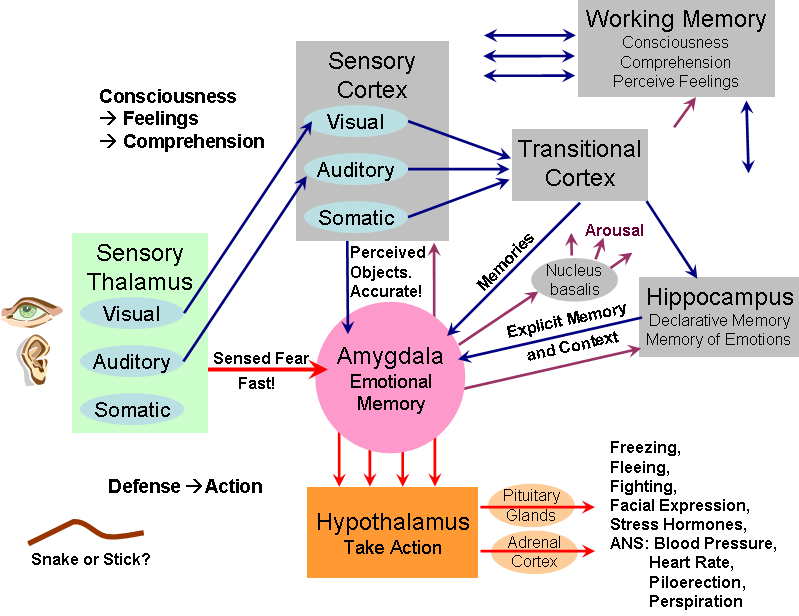
Innate and learned fear
Fear, however, is not restricted to snakes. We may fear many, many things: terrorist attacks, death, being a failure, war and especially nuclear war, criminal or gang violence, being alone, the future, cockroaches, spiders, heights, water, enclosed spaces, airplane flights, tunnels, bridges, needles, social rejection, school tests and examinations, public speaking and the existence of evil powers, demons and ghosts. Although a few of these fears may be innate, many of our fears are learned. For example, if we are in a car accident, as I was once when the car rolled over, we may learn to fear car rides, especially when we are riding on a curve.

Fear learning involves at least two steps. The first is to recognize or learn the context in which a danger or a threat appears. The second is to link recognition of this context to the aversive experience itself. In lab studies of fear mechanisms using rats or mice, the aversive experience may be a mild electric shock applied to the foot. In a typical experiment, we place a mouse in a novel cage. The mouse will form a neural representation of the cage. It will observe the features of the cage and form a memory of them, a process that involves the hippocampus. If we return the mouse to that cage the following day, the hippocampal circuits that recognize the cage will be reactivated as the mouse realizes where it is. If we shock the mouse while it is in the cage, its circuitry for the innate response to fear will also be active. Because the shock and the cage memory coincide in time, that cage context memory will become associated with the memory of the shock, a process that forms fear memory. If at a later time we return the mouse to that same context, that same cage, it will remain motionless except for breathing, a behavior called freezing, anticipating a shock. The mouse has learned that the particular cage poses a danger, and the cage elicits the fear response, freezing. Other cues can elicit fear responses when paired with an aversive stimulus. In humans these may be the smell of smoke, the sound of screeching tires or an alarm bell, or a social situation, such as meeting a person you know to be aggressive. Many types of stimuli can associate with fearful experiences, and with each one, the particular part of the brain that receives the fearful sensory information acquires during fear learning the ability to deliver the signal to the amygdala pathway that induces the innate fear response.


To make this process useful, we must have an awareness of our world from which we form memories of people, places and events. We link these memories to the emotions of fear, joy, sorrow, dread, horror, panic or anger that we experienced at the moment. The memories our brain records of things that take place in our daily life are called episodic memories. We form these memories without making a choice to do so; memory formation happens involuntarily. If we are asked what we had for lunch yesterday, we most likely can remember, even though we did not make a special effort to remember the dish. Our brains have records of the episodes and events that punctuate lives. If we want to remember an event, it is helpful to remember the context in which the event occurred. What time, what place, who was there? The hippocampus plays a large role in forming our representation of these contexts, both spatial and social. It can gather information from many regions of the neocortex. Each of these may be a component of an episodic memory that can be linked to the positive or negative qualities of the experience. When that context reappears, when we arrive at the same place, or associate with the same people, are offered the same food or hear the same sound, we will re-experience the positive or negative emotions associated with the past occurrence of that context.
The good and bad sides of fear, anxiety and stress.
In the healthy individual, these reactions are beneficial and promote survival. Indeed, they take place in other animals and have been preserved in evolution. However, the same systems that protect us may operate pathologically, causing long-term distress, emotional hardship, chronic disease and mental illness.
Generalization and stress. Although we may have experienced an aversive situation only under particular conditions, we may generalize that experience to other related situations. Although only one school teacher may have scolded us, we may fear all teachers. If we generalize our fears too much, we may experience anxiety, which is feeling fear when no actual threat or danger is imminent. Prolonged anxiety causes stress, which is the body’s adaptation a long lasting periods of fear responses. Stress may cause a persistent activation of the HPA axis and the chronic release of glucocorticoids.
Stress models. Animal models for stress can help us understand what sorts of situations may induce stress. These models also provide a means for studying stress. There are several ways stress can be modeled with rodents in the laboratory. A physical stressor can be applied, such as placing an animal in a tight cloth bag or in a wire restrainer for hours per day. Psychosocial stressors can also be applied, such as exposing a mouse to the urine of a predator, like to urine from a cat, or placing the animal on a small, highly elevated platform without protective walls. Stress also arises in young rat pups when they are separated from their mother or when a mouse is subjected to social defeat by placing it repeatedly in a cage with a second, dominant and aggressive mouse from which it retreats. It is easy to see how these situations that are stressful for a laboratory mouse find counterparts in exposure to violence, insects, heights, enclosed spaces like airplanes and other contexts in which humans may experience stress.

Childhood Stress and Adult Fear, Anxiety and Depression.
Depression and anxiety are common in our society and can arise from stress. Stress can affect our bodily processes and contribute to the risk of heart disease, mental illness and immunological disorders. Most significantly, we now realize that stress and anxiety that we experience as adults may be the result of adaptation by our nervous systems to early childhood adversity. Indeed, adversity suffered in utero during gestation caused by malnutrition of the mother can lead to medical, emotional and mental disorders in the offspring in adulthood. Effects of society and culture represent another way that stress can be transmitted. Widespread societal trauma, such as from warfare, slavery, economic or natural disasters or disease such as plague can impact our culture and society so that stress and anxiety are transmitted trans-generationally.

The Epigenetics Propagation of Stress.
Another proposed means for persistent effects of stress within an individual is epigenetic regulation. Editorial note (2026-10-03): this discussion concerns persistence from childhood to adulthood. It does not establish germline epigenetic inheritance of trauma across human generations; Heard and Martienssen (2014) distinguish these mechanisms and uncertainties. It is well established that early childhood stress can affect the adult, increasing the risk of high anxiety, mental illness, heart disease, maladaptive behaviors and even a chronic inflammatory state in adulthood that may predispose the individual to depression and immunological diseases. Early childhood stress can arise from many sources: an abusive parent, exposure directly or indirectly to drugs or violence, financial hardship, intolerance, or rejection by society through stigmatization.
Early postnatal stress has been shown to modify the genes that control the body’s response to stress. Moreover, these modifications can be maintained in adulthood. Although the mechanism is not well understood, one effect of early postnatal stress is a long lasting modification of the expression of the glucocorticoid receptor. The glucocorticoid receptor gene is modified epigenetically by early childhood stress. Without altering the sequence of A, G, T and C nucleotides in the gene’s DNA, chemical marks such as methylation of the DNA bases and amino groups on lysines in histones of chromatin are added near the sites that control transcription of the gene. These chemical marks limit the expression of the glucocorticoid receptor in the neurons that control the HPA axis. Reduced glucocorticoid receptor expression can alter negative feedback on the HPA axis. Editorial note (2026-10-03): McGowan et al. (2009) reported an association in selected postmortem hippocampal samples, not an inevitable outcome for every child exposed to adversity. Receptor reduction is distinct from complete absence, and HPA regulation varies with context (Spencer and Deak, 2017). This limitation also applies to the preceding figure’s generalized caption. In this way, early childhood stress may be pathologically transmitted to the adult.
Conclusions. Nature has given us the means to remember both joyful and fearful situations. These memories guide us through life and help us to make behavioral choices that promote our well being and survival. But our lives are complex and the mechanisms may not always operate in beneficial ways. Also we may be embedded in a culture that is abusive, and our behavioral life support systems may be stretched beyond capacity, with long lasting effects. Mistreatment in childhood may have consequences that reappear decades later and may be propagated to others through maladaptive or abusive behaviors. This ability of stress, anxiety and fear to resonate and be perpetuated within a society creates a responsibility shared by all citizens and by our social institutions. We must take care to free each individual from unnecessary stress, anxiety and fear starting at conception and lasting to old age. Stress, anxiety and fear in the individual is propagated to others, and thus care given to others is, in the end, care given to oneself.
 Edward Ziff received a bachelor’s degree in Chemistry from Columbia University in 1963 and a PhD from Princeton University in Biochemistry in 1969. As a postdoctoral student with Nobel Prize winner, Fred Sanger, in Cambridge he conducted early genome sequencing studies. Ed served on the faculties of the Imperial Cancer Research Fund in London and Rockefeller University in New York. In 1982, he joined New York University School of Medicine, where he is Professor of Biochemistry and Molecular Pharmacology and Neural Science and was an Investigator of the Howard Hughes Medical Institute. Ed researches brain function and neurological disease and was a Visiting Researcher at UFGD in Dourados. He lives in New York, has written for The New York Review of Books, coauthored a popular book on DNA, and is an amateur photographer, video maker, and painter.